

From Beijing’s perspective, Japan’s strategic choices are neither surprising nor trivial. They are unsurprising because Japan is a U.S. treaty ally, geographically exposed to growing Chinese military power, and embedded in a regional order long shaped by American primacy. They are consequential because Japan remains a major economic power, a technology hub, and a key player in Southeast Asia’s political imagination. A serious Chinese strategist therefore sees Tokyo not as a minor adjunct to Washington but as a pivotal middle power whose choices can either help stabilize competition or intensify it.
Chinese and Western analysts increasingly converge on one structural point; the world is not yet truly multipolar. Raja Mohan in his Foreign Affairs essay in February 2026 even argues that The Multipolar Delusion: And the Unilateral Temptation is dangerously naïve. Similarly, Tsinghua University’s Yan Xuetong argues that bipolarity between Washington and Beijing is the emerging reality and that China must think more seriously about alliances, not just partnerships. In my own essay for Geopolitika in December 2025 reaches a similar conclusion from a different angle. China’s GDP is roughly 130 percent of the United States’ by some measures in the Jennifer Lind’s framework, and both states alone exceed the combined economic and military thresholds associated with great-power status.
In short, it’s simple math according to the data in the Lowy Institute’s Asia Power Index 2025. India, Russia, and Japan all matter, but none can independently shape global outcomes across military, technological, economic, and diplomatic dimensions the way Washington and Beijing can.
That is the structural backdrop to China’s view of Japan. Beijing sees Tokyo as firmly anchored in the American camp but trying to maximize room for manoeuvre through minilateral diplomacy, economic diversification, and regional norm-building. From a Chinese standpoint, Japan’s shift is visible in numbers as well as rhetoric. Japan is moving from defence spending around 1.6 percent of GDP toward 2 percent by 2025–2027, and its military capabilities are being upgraded accordingly. Chinese analysts will not see this as a neutral technical adjustment. They will read it as evidence that Japan is preparing for a longer period of strategic competition and aligning more tightly with U.S. efforts to constrain China.
Still, a serious Chinese reading would not blame Japan alone for this outcome. China’s own behaviour has contributed materially to the regional backlash it now faces. Polling data show that distrust of China, while shifting, remains a defining feature of Southeast Asian strategic perceptions. The ISEAS State of Southeast Asia 2026 Survey found that China’s trust rating reached 39.8 percent. This exceeded distrust (35.2 percent) for the first time since 2019 and yet this partial rehabilitation is driven less by confidence in Beijing than by deepening anxiety over Washington’s erratic conduct under President Trump.
In fact, a slim majority of ASEAN respondents (52 percent) indicated they would align with China over the United States if forced to choose, reversing the 2025 result. At the same time, 61.9 percent of respondents remained worried about China’s growing regional influence, and for the first time, China’s interference in the domestic affairs of ASEAN member states rather than its South China Sea coercion emerged as the region’s primary concern, cited by 30.3 percent of respondents. Japan, notably, retained its position as the most trusted major power in Southeast Asia at 65.6 percent.
Similarly, in Australia, Beijing’s retaliatory tariffs reached 80.5 percent on barley and up to 218 percent on wine. In Canada, the detention of Michael Kovrig and Michael Spavor lasted over 1,000 days. In Lithuania, Chinese pressure extended beyond bilateral trade to efforts to exclude Lithuanian components from European supply chains. To Chinese strategists, these measures may have looked like calibrated signals. To many of China’s neighbors, they looked like warnings about what dependence can cost.
This growing distrust has fed Japan’s strategy of selective diversification. In my essay for the Institute for Security and Development Policy (ISDP) entitled The Dangers of a Stagnant China: The Necessity of Awkward Coexistence, I explained how Japanese firms are shifting away from overconcentration in China, not by abandoning the Chinese market, but by moving parts of their manufacturing and sourcing footprint to Southeast Asia and South Asia. At the same time, the China-based segment of Japanese business is being reconfigured toward “in China, by Chinese, for Chinese.” Beijing understands this move. Chinese leaders know that they remain central to regional manufacturing and that alternatives have limits because of infrastructure, human-capital, and scale constraints in Southeast and South Asia. But they also know that once trust erodes, diversification becomes a structural trend rather than a temporary adjustment. This is where Chinese views of Japan’s diplomacy in Southeast Asia become especially revealing.
In an article by associate professor Bao Guangjiang’s of Southeast Asian Studies, Xiamen University (Nanyang Institute)[1], he argues Japan’s “value-oriented diplomacy” is not merely about promoting democracy or human rights, but about reducing trust in China and ultimately containing Beijing by normative means. In this reading, Japan’s emphasis on emotional connection, “heart-to-heart” relations, ODA, NGO networks, education exchanges, and rule-based rhetoric is not benign public diplomacy but strategic trust engineering. The implication is that Japan competes not only through ships and trade agreements but through perception.
From Beijing’s perspective, that interpretation has real force. China itself cares deeply about “discourse power” and shaping narratives. The Chinese doctrine of telling “China’s story well,” building a “community of shared future,” and contesting what Chinese scholars see as Western dominance over global concepts and norms. Yet this is also where the mirror-image problem appears. Chinese officials often see their own rhetoric as inclusive and developmental, while viewing Japanese normative appeals as containment. Japanese officials often see their own diplomacy as principled and China’s language as cover for coercion. Both readings contain elements of truth.
A more sophisticated Chinese strategist would also recognize that China’s external assertiveness is taking place amid serious domestic strain. China’s property sector accounts for roughly 30 percent of GDP, that local-government debt estimates range from $8 trillion to $13 trillion, and that domestic consumption remains only about 54 percent of GDP. Youth unemployment reached 21.3 percent in mid-2023 before methodology changes lowered the official figure to 14.9 percent in 2025, though the real trend remains contested. The working-age population is projected to decline by roughly 200 million by 2050. China’s state-owned enterprises are often less productive than private firms, and that weak domestic consumption and soft-power deficits reinforce broader economic fragility.
This means Beijing does not necessarily welcome a region polarized against it. China still depends on an open trading system, sea lanes, access to technology, and stable demand from rich markets. In Foreign Affairs, Zongyuan Zoe Liu argues that China does not want the wholesale collapse of U.S.-led order but fears a United States that is less predictable and more willing to use residual military power in destabilizing ways. China imports about 70 percent of its crude oil from abroad, with roughly one-third passing through the Strait of Hormuz, and exports still account for around 20 percent of GDP. Beijing therefore prefers stability, bounded competition, and strategic autonomy—not an Indo-Pacific split into rigid camps.
That preference shapes how China likely sees Japan’s defence buildup. Chinese analysts may accept that Tokyo has legitimate security concerns. But they will worry that expanded missile capabilities, tighter intelligence integration with the U.S., and growing ties with Australia, India, and Europe could transform Japan from a defensive balancer into a more active participant in coalition-based containment. Whether that concern is overstated is beside the point. It is real in Beijing, and it affects Chinese threat perceptions.
What, then, would a prudent Chinese strategy toward Japan look like?
First, reduce the behaviors that make Japanese hard-liners look prescient. These include but are likely difficult such as maritime coercion, economic punishment, and sharp-edged diplomacy that confirms the image of China as a revisionist power. Second, preserve deep economic interdependence with Japan where possible, because Japan remains a source of technology, capital, and institutional legitimacy in Asia. Third, stop assuming that all Japanese diplomacy in Southeast Asia is simply a U.S.-driven containment project; some of it reflects decades of genuine trust-building that China has neglected. Fourth, recognize that a volatile or overmilitarized United States does not automatically benefit China if it destabilizes the system on which China still depends.
Japan, for its part, should understand that Beijing does not see itself as choosing chaos. It sees itself as defending room for maneuver in a system still heavily shaped by American military and financial power. But Chinese analysts should also understand that coercion narrows that room, because it drives states like Japan toward harder balancing strategies.
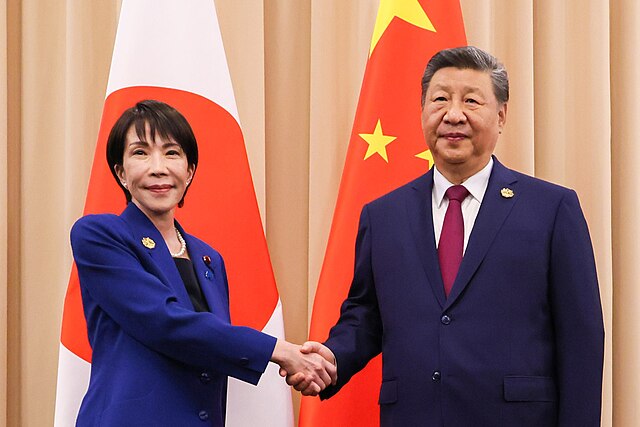
In that sense, Japan is not simply part of America’s alliance machinery. It is also a barometer. The more China pushes through pressure and coercion, the more Japan will harden. The most recent example is PM Takaichi Sanae’s refusal to step back from her November 7th, 2025 statement that a force reunification through military power by Beijing would result in Japan’s defense forces taking appropriate action.
The more China can reassure through restraint and credible economic openness, the more room remains for competitive coexistence. In an enduring bipolar system, neither Beijing nor Tokyo can escape the other. The real question is whether they manage that reality through disciplined competition or mutual strategic overreaction.
Endnotes
[1] Bao, G. (2016). Japan’s “value-oriented diplomacy” and the erosion of Southeast Asian countries’ trust in China. In China and the World/ Rìběn “jiàzhíguān wàijiāo” yǔ dōngnányà guójiā duì zhōngguó xìnrèn de liúshī. Zài Zhōngguó yǔ shìjiè (Vol. 5, pp. 87–99). Social Sciences Academic Press (China).