

Are the islands of the Scandinavian region becoming strategic pivots in the geopolitical reconfiguration of Northern Europe?
The Scandinavian region is experiencing a major resurgence of strategic interest. At the heart of this geopolitical realignment, the Baltic Sea, the North Sea and the Arctic Ocean are emerging as central theatres of renewed rivalry. This shift is being driven by the return of tensions between NATO and Russia, Finland’s and Sweden’s recent accession to the Alliance, and the gradual opening of Arctic shipping routes. In this rapidly changing environment, islands are becoming essential strategic footholds, serving simultaneously as interfaces, chokepoints and potential platforms for the projection of power.
From Gotland*, a military pivot in the Baltic Sea, to Greenland**, which lies at the centre of global ambitions and emerging polar routes, and Svalbard***, an Arctic territory governed by a unique legal regime, these islands embody a wide range of strategic interests: control over maritime routes, strategic surveillance, access to resources and the assertion of sovereignty. Other territories, such as the Åland Islands**** and the Lofoten archipelago*****, illustrate more indirect but equally significant forms of geopolitical centrality, combining political and economic considerations. Against this backdrop, it is worth examining the place these territories occupy in contemporary power dynamics: to what extent are the islands of the Scandinavian region becoming strategic pivots in the geopolitical reconfiguration of Northern Europe?
Islands and archipelagos that appear peripheral but play a structural role in Northern Europe’s maritime order
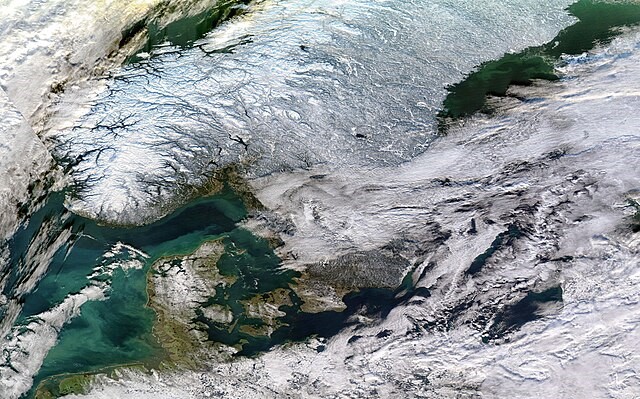
The Scandinavian region is defined by its maritime environment: the Baltic Sea, the North Sea, the Arctic Ocean and the Gulf of Bothnia. These interconnected waters profoundly shape the region’s geographical and strategic organisation while structuring the coastal territories surrounding them. This setting has produced a fragmented geography characterised by numerous archipelagos and deeply indented coastlines, particularly in Norway and Sweden. Within this broader landscape, islands occupy a distinctive position. Although often regarded as peripheral because of their isolation and natural constraints, they help shape regional movements and balances. By serving as transit points, staging grounds and positions from which surrounding waters can be monitored or controlled, they contribute to the strategic hierarchy of the region’s maritime spaces. In the Baltic Sea, for example, these islands lie along busy shipping routes connecting Northern Europe’s major ports with the Russian bases of Saint Petersburg and Kaliningrad. Farther north, the Norwegian archipelagos extend these strategic interfaces towards the Arctic, reinforcing their role in organising and monitoring maritime traffic. Long treated as marginal territories, their peripheral status must now be reconsidered. On the one hand, several islands enjoy special legal statuses that reveal their latent strategic importance. The Åland Islands, for example, have been demilitarised since the nineteenth century, reflecting their sensitivity within the regional balance of power. Similarly, Svalbard is governed by a special legal regime that partially internationalises its economic exploitation while recognising Norwegian sovereignty. On the other hand, although peripheral when viewed from a European perspective, these territories occupy a central position at the regional level. They shape relations between coastal states and lie at the heart of major maritime flows. Greenland, situated alongside emerging polar routes, is a compelling example.
Growing strategic importance amid rising tensions and militarisation
The deterioration of relations between Russia and Western countries, combined with NATO’s enlargement to include Finland and Sweden, is redefining the strategic importance of Northern Europe’s maritime spaces. Within this evolving security environment, islands are emerging as essential footholds for power projection, surveillance and the control of maritime and aerial movements. Since the 2010s, Northern Europe has once again become a theatre of major geopolitical tension. The Baltic Sea and the Arctic Ocean, in particular, are increasingly seen as potential zones of confrontation between Russia and NATO member states. The presence of the heavily militarised Russian exclave of Kaliningrad reinforces this dynamic by providing Moscow with a strategic stronghold at the heart of the Baltic region. The Swedish island of Gotland, located in the centre of the Baltic Sea, occupies a position from which the maritime and air lines of communication linking the Baltic states to the rest of Europe can be monitored and potentially controlled. Its gradual remilitarisation since the mid-2010s reflects a growing awareness of its strategic significance in a deteriorating security environment. Beyond Gotland, several islands form part of broader integrated defence networks that contribute to securing NATO’s northern flank. In the event of a crisis, they could serve as forward bases for the deployment of forces while enabling NATO to monitor or obstruct an adversary’s movements. Their function as strategic barriers reinforces their centrality within contemporary military planning. Yet the geopolitical importance of the Scandinavian islands extends beyond their military value. Some are governed by special legal arrangements that make them particularly sensitive. The Åland Islands, for example, enjoy a regime of autonomy and demilitarisation guaranteed by international agreements. Svalbard offers another prominent example of legal complexity. Although placed under Norwegian sovereignty by the 1920 treaty, the archipelago grants extensive economic rights to the other signatory states, including Russia. This arrangement creates a potentially contentious space of coexistence in which ostensibly civilian activities may acquire an implicit strategic dimension. Amid intensifying rivalry in the Arctic, ambiguities surrounding Svalbard’s status could be exploited by state actors. The growing strategic importance of the Scandinavian islands therefore cannot be reduced to the question of militarisation. It is also prompting a reassessment of their legal status, which can serve either as a source of leverage or as a point of friction within regional power relations. The central problem is that, with the exception of Greenland, these islands are currently either only lightly militarised or not militarised at all.
The Arctic region
The growing strategic importance of the Scandinavian islands cannot be explained solely by regional tensions in Northern Europe. It is also part of a deeper transformation of the global geopolitical order, marked by the renewed strategic value of the Arctic as it gradually becomes a new theatre of international competition. Within this emerging geopolitical landscape, the Nordic islands and archipelagos occupy a central position because of their geographical location, potential resources and role in controlling new maritime routes. Climate change is one of the principal drivers of the Arctic’s geopolitical transformation. The seasonal retreat of the sea ice is making previously inaccessible areas easier to reach and increasing interest in northern shipping routes. The Northeast Passage, which connects Europe and Asia along Russia’s northern coastline, together with other emerging Arctic routes, could gradually alter the balance of global maritime trade. Against this backdrop, islands situated on the margins of the Arctic are acquiring renewed importance. Svalbard, Norway’s northern archipelagos and, above all, Greenland are becoming observation posts, logistical hubs and platforms for power projection in a rapidly changing region. Iceland must not be overlooked either. It is a discreet but important pivot within the GIUK Gap—Greenland, Iceland and the United Kingdom—and is situated near the exit of the northern and northeastern Arctic passages. The locations of these islands make it possible to monitor maritime traffic, support scientific and military missions, and facilitate the possible exploitation of new resources. Russia regards the Arctic as essential to its national security, energy economy and military capabilities. It has developed a substantial presence there, particularly around the Kola Peninsula (Murmansk, Nagurskoye, Temp and Kotelny) and the Barents Sea (Severomorsk, Vidyayevo, Polyarny, Gadzhiyevo and Zaozersk). In response to this expansion, the United States is attaching increasing importance to Greenland, particularly because of its strategic position between North America and Europe. The American military presence on the island underscores Greenland’s importance to the defence of the North Atlantic and the surveillance of Arctic approaches. Although geographically distant, China is also showing growing interest in the Arctic, which it regards as a potential transport corridor and source of natural resources—a development that also highlights the importance of the port of Kirkenes in Norway’s far north. The renewed strategic value of the Scandinavian islands does not, however, rest solely on military considerations. It is also shaped by the tension between economic exploitation and environmental preservation. The Nordic islands possess fisheries, energy reserves and mineral resources that are likely to increase their strategic importance in the decades ahead.
Greenland illustrates this development particularly clearly. Its potential mineral wealth, especially its deposits of rare-earth elements, is attracting interest from a range of international actors because of the importance of these materials to energy-transition technologies. This prospect is intensifying debates over political autonomy, economic sovereignty and external influence. On a different scale, Norway’s Lofoten Islands demonstrate that the strategic value of island territories is not confined to their military or extractive potential. The debate over oil development in the region highlights the difficult trade-offs between energy security, economic development and the protection of fragile ecosystems. These tensions illustrate a new dimension of contemporary geopolitics: power is no longer measured solely by the ability to control a territory, but also by the capacity to manage its uses sustainably.
The islands of the Scandinavian region therefore stand at the intersection of several powerful dynamics: military competition, the opening of the Arctic, access to natural resources and environmental pressures. Their growing importance reflects a fundamental shift in their geopolitical status. Once regarded as peripheral territories, they are gradually becoming major points of connection between regional powers and global strategic interests. The islands of the Scandinavian region can therefore be considered genuine strategic pivots in the geopolitical reconfiguration of Northern Europe. The question that remains is whether this newfound centrality will continue to be managed primarily by the Nordic states or lead to the increasing internationalisation of these territories, potentially transforming them into new theatres of confrontation among the great powers.
Notes
*Gotland (Sweden)
Located at the heart of the Baltic Sea, Gotland forms part of an expanded chokepoint from which regional maritime and air traffic can be monitored and potentially controlled. The island functions as a strategic barrier within an area whose peripheries—Finland, Russia and the Baltic states—are heavily militarised. Its remilitarisation, centred on a combined-arms battlegroup known as Stridsgrupp Gotland, illustrates the return of territorial deterrence and power-projection strategies in a Baltic theatre that has once again become central to tensions between Russia and Europe.
**Greenland (Denmark)
A genuine geostrategic pivot in the Arctic, Greenland occupies a crucial position at the intersection of American, European and Asian interests. Its geographical location and the American military presence at Pituffik Space Base make it a key component of global surveillance and power projection. The island also embodies the challenges surrounding the security of natural resources and emerging maritime routes, placing it at the heart of the geopolitical reconfiguration of the polar regions—and of Donald Trump’s ambitions.
***Svalbard (Norway)
Located deep within the Arctic, the Svalbard archipelago occupies a strategically important position between Europe and the North Pole. Governed by the 1920 treaty, it remains under Norwegian sovereignty while granting economic rights to several other states, including Russia—which continues to maintain a presence there—and China. Its proximity to emerging Arctic shipping routes, together with its role in climate research and strategic surveillance, makes it an important focal point in the Arctic’s intensifying geopolitical rivalries.
However, the 1920 treaty prohibits the militarisation of the archipelago.
****Åland (Finland)
A demilitarised archipelago, Åland serves as an institutionalised buffer zone within an increasingly tense Baltic region. Its status reflects a strategy of neutralisation inherited from the balance of power established in the nineteenth century, but now confronted by intensifying regional rivalries. It therefore illustrates the limitations of demilitarisation regimes amid the contemporary reconfiguration of regional power relations.
*****Lofoten (Norway)
The Lofoten Islands form part of Norway’s strategic depth and NATO’s broader surveillance posture towards Russia. Situated at the interface between the Atlantic and the Arctic, they contribute to the monitoring of maritime lines of communication and the protection of fisheries and energy resources. They illustrate the growing strategic value assigned to peripheral territories within contemporary security planning. As a NATO member, Norway maintains military capabilities in the north of the country, particularly farther east around Tromsø and towards the Russian border. The Lofoten Islands themselves, however, have not been militarised.
Further reading
Arctic
SIPRI (Stockholm International Peace Research Institute) www.sipri.org
→ Reports on Arctic militarisation and maritime routes.
Arctic Council https://arctic-council.org
→ Documents on governance, environmental issues and international cooperation. Although the organisation has a limited focus on military affairs, it remains an essential source.
Center for Strategic and International Studies (CSIS) www.csis.com
→ Analyses of the role played by islands such as Greenland and Svalbard in great-power rivalry.
Baltic
→ Studies on the defence of the Baltic states and the role of strategically important islands.
International Institute for Strategic Studies (IISS) www.iiss.org
→ Regional military assessments.
FOI (Swedish Defence Research Agency) www.foi.se
→ An indispensable source of research on Gotland and the Baltic region.