

In Trump’s universe, there are neither fixed red lines nor long-term strategies. Everything boils down to what benefits Donald Trump here and now. The result is a foreign policy in which allies are pressured, adversaries are tested—and no one can be certain what will actually apply tomorrow.
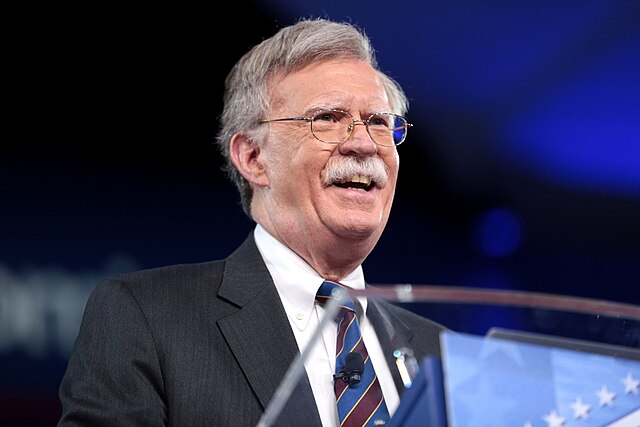
In this wide-ranging interview, John Bolton—former U.S. ambassador to the United Nations and national security adviser under Donald Trump—offers a ruthless analysis of Trump’s handling of the war in Ukraine and the consequences for the transatlantic relationship. With sharp criticism of a transactional worldview lacking red lines, strategic consistency, or institutional grounding, Bolton paints a picture of a president driven by personal prestige rather than American or allied security interests.
Bolton is regarded as one of the United States’ most prominent foreign-policy hawks, with decades of experience within the Republican national-security establishment. He has previously served as assistant secretary of state, U.S. ambassador to the UN, and adviser to several Republican administrations, and is known as an uncompromising defender of American power projection, NATO, and a hard line on Russia, Iran, and China. For that very reason, his assessments carry significant weight when he warns that Trump’s Ukraine policy could undermine alliance solidarity, deterrence credibility, and the United States’ long-term strategic position.
Bolton agreed to speak with Geopolitika on the condition that we would not discuss the ongoing case against him in the U.S. legal system. According to Bolton himself, he is not permitted to discuss the matter publicly.
– What do you make of Trump’s handling of the war in Ukraine so far? Given the major disagreement between his administration and most European capitals, how do you think his actions will influence the transatlantic relationship?
– Substantively, Trump doesn’t have any red lines based on American national security considerations, or NATO considerations, or even Ukrainian considerations. To him, as with almost everything—since he doesn’t have a philosophy, doesn’t do grand strategy, and doesn’t even do policy the way we normally understand that term—it’s all transactional. It’s all about: can I make a deal?
And he’s motivated here, again, not by national security analysis; he’s motivated by getting the Nobel Peace Prize. This is something that he’s been thinking about since his first term, and it could not be clearer. Barack Obama got the Nobel Peace Prize in his first year in office, and he didn’t think Obama deserved it, an opinion many people share, myself included. I think Obama didn’t get it because of what he did; he got it because he was Obama.
So, Trump thinks, “Well, he got one, I should get one too.” And four years went by, he didn’t get it. Now the fifth year has gone by, he still hasn’t gotten it. So, in his head, he got three years left to go, so he wants to obtain — notwithstanding having resolved eight wars in the last eight months, I think is his latest number— a deal on Ukraine as soon as possible.
Now, I know this is very hard for people get their arms around. I found it hard too when I worked for him. It’s not policy that’s driving him; everything it’s about Donald Trump. He wants to be able to say, “I pushed these people together, I leaned on Putin, I leaned on Zelensky, and I got a deal, so now I want the Nobel Peace Prize.”
So that’s why Witkoff and Kushner are in Berlin, and we’ll see what happens today. I just have press reports about what happened, and it doesn’t look like Putin is moving very much. It looks a lot like Zelensky’s beginning to move a little bit, especially with what came out yesterday, that he’d be willing to forego NATO membership so long as Ukraine got adequate security guarantees.
If this information accurate, I think that’s a big mistake. I think this whole idea that exists a deal with Russia that will last longer than it suits Russia’s geopolitical purposes is an illusion, and will not provide adequate safeguards for Ukraine. That’s just my view.
– There are different opinions about which direction the war is going. Some people say Russia is definitely winning, while other people say that Ukraine still stands a good chance to achieve a favorable outcome. What’s your view of the war as it’s approaching its fourth year?
– I think the view in Moscow is that they think their war of attrition is succeeding. Their time frame is that Ukraine will crack sometime in the spring or summer. And I do think the Russians are advancing on the battlefield, but continuing to advance small amounts of territory at an enormous human cost. They have a different calculus on the value of human life than we do, so they’re prepared to continue to fight.
So, Putin thinks that time is on his side. And notwithstanding the problems with their economy and public discontentment in Russia, there is a theory out there that Putin actually is better off having a war. He can blame it on the West and on NATO. So, he doesn’t feel any domestic pressure, politically or economically, to stop.
I think that is a big mistake from his own point of view. I have thought for a long time he would be better off with a ceasefire to rebuild his economy and rebuild his military. But that obviously isn’t his point of view, although he would take advantage of a ceasefire to do that. So, Russia’s not in the mood to compromise.
And so far, Trump really has not leaned on the Russian side the way he’s leaned on Zelensky. And I think that’s why Zelensky continues to make concessions, which, in my view, are a mistake. Now, depending on what happens today, if he makes the NATO concession and perhaps others—he hasn’t apparently been willing to bend on the Russian territorial demands—Trump might well think, “well, I’ve squeezed him pretty hard. Now I’m going to go back to Putin, and this time I’m finally going to squeeze him.”
That’s theoretically possible. But I think Putin may save us from ourselves. I don’t think he’s in the mood for any meaningful peace treaty yet. I don’t think he thinks he has gotten as much as he could get out of Zelensky. So, I’m not at all sure they’re going to make the Christmas deadline. But even if they do, I don’t view this as a real answer. I mean, if I were Ukraine and I had even Article 5 guarantees from Donald Trump, what reason is there to believe them?
– Talking about credibility: Donald Trump has proven to be a master at setting artificial deadlines and red lines, and then somehow just ignoring them afterward. There was the threat of secondary sanctions against buyers of Russian oil that was simply ignored. And then there was the recent ultimatum to accept the peace treaty that was forced upon Ukraine, which they had a week to accept. It was ignored.
So, all these things considered, when does Donald Trump start to look like a paper tiger—someone who just issues all these threats and then nothing happens? Especially as we look at Russia, but also how this would influence security in the Pacific.
– Well, I think we’re already there, frankly. That’s where the TACO—Trump Always Chickens Out—thing comes from. I mean, I think most people look at the negotiations between the US and China over rare earths and trade tariffs over the course of the past year as a win for China.
And, you know, a Trump-negotiated deal with China would be the biggest trade deal in history. And that’s what he really wants. That’s what he wants it to be a done deal when he visits China in April, and it has become an obsession for him. Trump does not want anything to get in the way of this trade deal with China. And Xi Jinping knows that, and he’s playing it very well.
I also think Putin knows what Trump wants – the Nobel Peace Prize – and plays him accordingly. So, while Putin won’t want to be the obstacle between Trump and the prize, he’s worked pretty hard—and pretty successfully—to pin the blame on Zelensky so far. So what will determine things, I think, is whether whatever Zelensky finally agrees to today gives Putin enough ammunition to say to Trump:
“This guy doesn’t really want peace. I do, Donald, but Zelensky does not.” And that would be ideal for Putin. Again, mistakenly in my view, but ideal for Putin. The ceasefire talks break down and the war continues—he’d be happy with that.
– What about Trump’s credibility among allies when he behaves like this? We all agree that Europe must do more for collective defense, and he has actually done something to push the Europeans in the right direction there. But at some point, all this talk and all this lack of consequences should affect his credibility, among foes and allies alike, right?
– Well, I hope it does. I’ve been saying—and I continue to believe—that Trump is an aberration in American politics. It’s true, he got elected twice, but he had two weak opponents. He was unlucky in 2020, but very lucky in 2016 and 2024 to be running against Clinton and Harris.
What people in Europe should be thinking is not how to respond to a world supposedly changed irrevocably by Trump, but rather that Trump will be gone in three years. That is a long time, admittedly, but still not long enough to hand the Russians what the Soviets failed to achieve during the Cold War.
There is indeed a split between Europe and the United States, but the political establishment in the US remains firmly committed to the transatlantic relationship. In Congress, among both Republicans and Democrats, support for Ukraine remains high. The same is true for support for NATO, including among Republicans. They’re just intimidated by Trump and unwilling to say it publicly.
But I think that’s what they believe. Just look at the Defense Authorization Act, which is hopefully going to be voted on by the Senate this week, after it passed the House last week. If one looks at the provisions of that bill, it’s very much a traditional Reagan–Bush kind of bill on the Republican side.
So, I think we need to do our best to mitigate the damage Trump can still do over the next three years and then figure out how to repair it. Because Trump has definitely caused damage—he’s hard to deal with and irrational at times. We must therefore avoid taking steps that would affect the alliance in ways that can’t be fixed.
– From this side of the Atlantic, it looks as though both the American right and left are drifting further toward the fringes, squeezing out centrist politics. Extremes in both parties increasingly dominate political debate, and they are not especially favorable to Europe. As a result, whatever comes next feels highly uncertain for us. Should we be worried?
– I think it’s too early to tell. Just look at the Republican Party, where JD Vance doesn’t have a lock on the nomination in 2028. I think there are a lot of other people who could take that position. As a matter of fact, I actually think that we’ve passed peak Trump over the past 45 days, beginning with the off-year elections in November.
Looking at the splits within the MAGA base—over Marjorie Taylor Greene, over Jeffrey Epstein, as well as a lot of social issues—we’re moving into a new period of Trump’s political life. It’s not accurate to say Trump is at the end of the road, but we have indeed passed peak Trump. The direction of travel is down from now on.
How far it goes, I don’t know. But he’s now increasingly seen as a lame-duck president, so more people are willing to stand up to him. This happened in Indiana, where the state Senate, controlled 40 to 10 by Republicans, refused to redistrict the House of Representatives district lines. And this is the kind of resistance that I would have liked to see a long time ago, and now it’s finally starting, and I think other people are taking note of it.
Furthermore, it’s important to remember that only three times in American history has a vice president gone directly from the vice presidency to the White House. One was John Adams, right after George Washington. He had been vice president for the first eight years and got his own term, but was defeated for a second term. The next one was that very well-known president, Martin Van Buren, in 1836, who succeeded Andrew Jackson. And since then, the only time it happened again was with George H.W. Bush, who succeeded Reagan.
So, it’s not at all certain that JD Vance gets the Republican nomination, or that he doesn’t lose to a Democrat in the presidential if he actually gets it. In this context, it’s the left that has momentum and energy at this point in time in American politics. But the Democrats can be their own worst enemy. They do it over and over again.
That’s why they lost the 2024 election. Biden didn’t step down in time, and they had no choice but to nominate Kamala Harris, who couldn’t separate herself from Biden. Anyway, they’ve got plenty of people who are center-left, respectable, normal people, who have an excellent chance to beat J.D. Vance if they’re nominated. So, I think it’s very much up in the air.
But if you simply assume the worst, you open the possibility that Trump could take advantage of what European leaders are saying—such as Chancellor Merz arguing for independence from the United States—to claim, “Well, look, we don’t want to do anything the Europeans don’t want us to do. We’ll just withdraw from NATO if that makes them happy.” We obviously don’t want to give him that opportunity.
– Traditionally, Democrats and Republicans have shared a broad consensus on foreign policy. Do you think that consensus will endure, or have we reached the end of the road for bipartisan politics when it comes to security issues?
– It’s hard to say. I think the Democrats have more of a tendency toward isolationism in many respects than Republicans. It just comes and goes in different fashions and in different patterns. But I think out in the country, among Republicans, support for a traditional Reagan–Bush approach remains very strong. It’s just that Trump is in the White House, and people tend to support the leader of their party.
But I think support for Ukraine in particular is much stronger than people think, which is why it’s important that Europe not draw the wrong conclusions and assume the worst case at this point in time. Because otherwise, it could become a self-fulfilling prophecy. And a lot of Americans would say, “Look, if the Europeans don’t care so much about Ukraine, then so what? Why should we care?”
– Given China’s rise, how valuable do traditional, security-oriented policy experts in the United States consider the relationship with Europe? There are, of course, significant differences of opinion with European policymakers across a wide range of geopolitical issues. At what point, if any, does the United States simply say enough is enough and go its own way?
– Well, I don’t think most people are ready to say that. I think Trump and J.D. Vance may be ready to say that. But remember, most of this stuff was not debated during the 2024 campaign. It just wasn’t even an issue. A lot of people in Trump’s own base are very surprised that he claims he’s solved eight foreign wars in the last eight months, because they say, “what was he spending all his time on that for? What about the economy, which we’re worried about?”
Furthermore, there is the idea that the United States may be on the verge of war to overthrow Maduro in Venezuela. A significant part of the MAGA base is asking, “I thought we were trying to end the endless wars. Why is he starting another one?” These are just a few examples of the splits within Trump’s support base, and of why it is Trump’s unique personal appeal that has kept this highly disparate MAGA coalition together. I don’t think Vance has the charisma or the capacity to hold it together as Trump fades from the scene.
So that’s why it’s important not to assume that what Trump says reflects either a majority of Republicans or a majority of Americans. So yes, I think Trump is an aberration and that things will go back to a more normal line when he’s gone. But it may take some time before we get there.
There may be significant differences of opinion among Americans on a range of issues, but there is a broad understanding that a forward presence abroad enhances U.S. security, and that it is an American strength that provokes its adversaries. I think that view is widely shared.
And as frustrating as it is, people just have to grit their teeth and assume that we’re to get through this. Instead of amplifying the differences and problems Trump is creating, we need to keep the ultimate strategic objective in mind and work to mitigate the damage, so that we have the opportunity to correct course after he leaves office.
– Where do you stand on the US military posture balance between Europe, the Middle East, and the Pacific? Should the US drastically pivot to Asia?
– Well, America is a global power, and we’ve got global responsibilities, global interests, global friends, and global allies. We’ve done this pretty successfully – but not without some problems – since 1945. There’s no reason we can’t continue to do it in the 21st century as well.
If you look at the rest of this century, obviously China—by size, population, economics, and military capabilities—is the biggest threat by far. But it’s the biggest threat not just in the Indo-Pacific, but everywhere around the world.
You know, Xi Jinping and Vladimir Putin have effectively formed a new axis. It’s not fully consolidated yet, but it is clearly taking shape. About a year and a half ago, they declared a partnership “without limits,” and I think China has done a great deal to help sustain Russia’s war in Ukraine—by buying more oil and gas, continuing to purchase sophisticated weapons systems, and laundering sanctioned Russian money through China’s opaque financial system into global markets.
And the Chinese will expect the same thing from Russia if they go after Taiwan at some point in the near future. So, we can see this axis forming, but unlike during the Cold War and the Sino-Soviet alliance, this time the Chinese are in the driver’s seat. And they’ve got their satellites. They’ve got North Korea, Belarus and Iran in Eurasia, and Cuba, Nicaragua, and Venezuela in the Western Hemisphere. They also had Syria until the Assad regime fell.
So my point is that, whether we are talking about European members of NATO or countries like Japan and South Korea, this is a challenge that is coming together for all of us at the same time. From Europe’s own perspective, this is critically important. Nearly twenty years ago, José María Aznar, the former prime minister of Spain, argued that NATO should be expanded. I agreed with that view then, and I still think it makes sense today.
We should therefore consider bringing in Japan, Singapore, Australia, Israel – perhaps other countries as well – and turn NATO into a genuinely global alliance. After all, we now have North Korean troops fighting for Russia in Ukraine, which likely marks the first time East Asians have fought in Central Europe since the era of Genghis Khan. But it does not stop there. South Korea is selling artillery and ammunition to Poland because it understands that developments on that front directly affect its own security.
Japan also understands why Russia matters in Europe. It faces both China and Russia directly, as does South Korea. When you step back and look at the bigger picture, all of these elements fit together. This is not about favoring one region of the world over another; it is about identifying threats to our security wherever and wherever they arise.
And once one sees how these issues are interconnected, Europe’s position – especially its economic dependence on China – looks particularly vulnerable. German automobile manufacturers, for example, feel this very acutely. So, this is not only about how we view Ukraine. It is also about how we assess China’s posture toward Taiwan. It’s all interconnected.
– So, you don’t see any imperial overstretch of the American military?
– I think we simply need to spend much more on defense overall. The United States currently has about 285 warships at sea, a number that has declined over the past several years. In that context, it is worth recalling that a bipartisan commission roughly ten years ago concluded that the fleet should be closer to 325 warships. Given how much the security environment has deteriorated since then, the required number is probably even higher today.
Just look at the Pacific Ocean. It is vast, and from a naval perspective that is where the bulk of resources ought to be concentrated. But at the same time, warfare is no longer confined to traditional domains. We now face an entire spectrum of new challenges—gray-zone or hybrid warfare, asymmetric warfare, and cyber warfare among them. We need to develop credible capabilities in all of these areas as well.
The West made a major mistake after the collapse of the Soviet Union, when many declared the “end of history” and assumed that globalization would resolve most security problems. Defense budgets were slashed across the board, and now we are paying the price. We have to rebuild those capabilities, and we have to do it quickly.
In that sense, I believe the United States needs to return to spending something like 5 to 6 percent of GDP on real military capabilities—not the nominal 5 percent NATO target, which in practice amounts to about 3.5 percent on actual military forces, with the rest going to infrastructure and related costs. There is a great deal of lost ground to recover, and little time to do it.
When you look at the emerging China–Russia axis, the potential threats are global. They can arise in Europe, the Middle East, Asia, Africa, or Latin America. That is why Venezuela is a serious national security issue for the United States today, given the scale of Russian, Cuban, Chinese, and Iranian interests involved—arguably more significant now than during the attempts to overthrow Maduro in 2018 and 2019.
So, do I believe that the United States has the military capacity to operate in multiple regions at the same time? Yes, but it is fundamentally a question of awareness and political will. For too long, and certainly under Trump, political leaders failed to explain to voters that the threats never went away. The end of the Cold War did not mean the end of history.
We are now paying the price for that failure. You cannot simply tell people that the country needs to spend 5 percent of GDP on defense and expect automatic consent. That level of commitment has to be explained and justified. Too few political leaders have been willing to do that work. But in terms of capability, I do not think the United States faces a fundamental limitation.
– The real question—the million-dollar question—is how to make the populations of democratic societies more engaged with geopolitics and security policy. How do you explain why it matters to stand up to China, or why Iran must not be allowed to acquire a nuclear weapon? On the whole, publics in the West are largely apathetic toward these issues.
– Yet opinion polling in the United States tells a more nuanced story. There is broad bipartisan support for a tough policy on China and strong opposition to Iran. There is also, particularly among Republicans, growing support for Ukraine. What is missing is sustained political leadership capable of translating those instincts into understanding.
In a democratic society, leaders have to make the case. They cannot expect people to accept major strategic commitments automatically. Historically, it has often taken a shock or a crisis to focus public attention. I hope that does not happen again—but it would be naïve to rule it out.
China, for example, may see an opportunity to move on Taiwan. I do not necessarily think that would take the form of a direct invasion, but a blockade or some form of coercive control is entirely plausible. If that were to happen, it would almost certainly awaken public opinion—but at a terrible cost. The losses would be severe and would take years to overcome.
That is often how it unfolded during the Cold War. It took dramatic events—such as the Soviet blockade of Berlin—for people to grasp the nature of the threat. The hope now is that we can recognize those dangers without first having to live through a comparable crisis.
– So, do you believe that people in our democratic societies will eventually rise to the occasion and do what is necessary to protect our way of life and our political systems?
– Certainly, in the United States that has been the historical pattern. We did it three times in the twentieth century, so I see no reason why we could not do it again. That said, I would much prefer not to wait for a catastrophe to force that awakening.
That is precisely why Ukraine matters so much. I do think this is increasingly understood among Americans in general. Trump does not understand it, but in Congress—although Republicans remain intimidated by Trump—I do not think large numbers of them actually agree with him on Ukraine.
– What, then, should Europe do? If you were Europe’s chief geopolitical adviser, what would your advice be on protecting itself from what appears to be an increasingly unreliable United States?
– First, Europe should not assume that what Trump is saying today represents American policy far into the future. That assumption is simply wrong. The real question is how, in the face of immediate threats such as Ukraine, Europe can grit its teeth and get through the next three years without sustaining lasting damage, while laying the groundwork for a closer alliance afterward.
I also think Europe risks making a mistake by concluding that because it cannot trust Trump, it must immediately build entirely independent weapons systems. It is possible to spend enormous sums of money trying to construct a new defense-industrial base without actually increasing real defensive capability—because that process takes time. You cannot simply snap your fingers and make it happen. Questions about burden-sharing and division of labor should therefore continue to be handled within the NATO framework.
Moreover, Republicans in Congress are pushing for much higher defense budgets than Trump himself likely wants. How that plays out will become clearer over the coming year, particularly if the defense authorization bill that the Senate is preparing to pass includes a significant increase over Trump’s requested level. I expect more of that pressure going forward.
My central advice to Europe is this: in as many ways as possible, focus on building a solid foundation for the post-Trump geopolitical environment—one in which the threat level is almost certainly going to be higher. Europe should avoid moving sharply in one direction in ways that allow Trump to veer off in another. That admittedly requires more effort than if the United States had a normal president—but we do not.
I hope that changes in three years. If it does not, the transatlantic split may become irreparable. And once that separation hardens, it will only make it easier for the China–Russia axis to defeat us one by one.
– Should Europe really put all its eggs in the U.S. basket and simply hope for the best? From our perspective, that seems like a risky gamble.
– It may not be a comfortable position, but there are not many realistic alternatives. In the foreseeable future, Europe cannot replicate America’s intelligence capabilities, strategic transport, or the logistical infrastructure that underpins NATO. It simply cannot. This is not just about building more weapons factories or producing more aircraft, tanks, and ships. Those assets only matter if they are embedded in a much broader system of capabilities, and Europe does not have that system on its own.
I understand why this is frustrating—deeply frustrating. Believe me, I know how aggravating it is to deal with Trump. But the real question is how to keep working toward what is still in everyone’s long-term interest, despite what is essentially an aberration in the White House. Admittedly, if someone like Vance were to win in 2028, Europe might well decide to go its own way. But that is still a long way off.
European policymakers therefore need to avoid a self-fulfilling prophecy—saying, “We see the writing on the wall; it’s going to be Trumpism forever.” That gives Trump far more credit and staying power than he has earned or is likely to accumulate over the next three years.
– So, in essence, your advice is to hang in there, avoid drifting too far from the United States, and not provoke Trump unnecessarily—because doing so could itself become a self-fulfilling prophecy and leave Europe worse off.
– Yes, exactly. And if Europe pushes Trump in the wrong direction, countries on NATO’s eastern flank—Estonia, for example—become vulnerable much sooner. The Russians have never crossed a NATO border with conventional forces. That matters. Of course, they have harassed all of us, tried to influence our elections, and conducted gray-zone operations—such as the cyberattacks on Estonia several years ago.
We have not responded particularly well to those actions, and that is likely to continue as long as Trump is president. But imagine a scenario in which Russian conventional forces crossed into Estonia next year because Moscow believed Trump would not respond, or because it believed the Europeans and Americans had split. That would effectively mark the end of NATO.